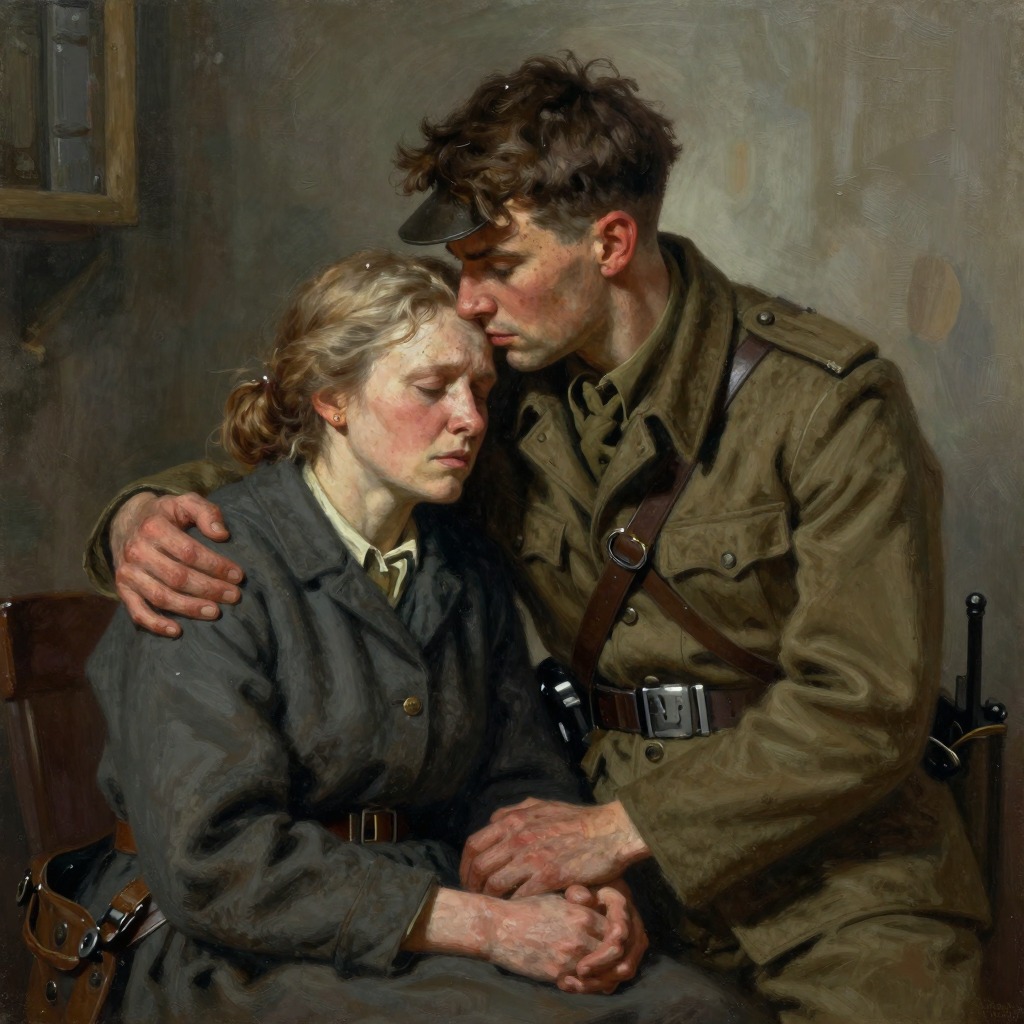
Jam from Mother
The jam that Paul Bäumer's mother makes for him is a small, intensely personal object that carries the full weight of maternal love, domestic scarcity, and the impossible distance between the home front and the trenches. It appears at two crucial moments—first when Paul receives it during his leave, and later when he shares it with his comrades after returning to the front—and in each instance it becomes a tangible link to a world of care that the war has made almost unreachable. More than a ration supplement, the jam is a vessel for memory, guilt, and the fragile hope that something of home can survive the destruction.
Origin and the Circumstances of Its Making
The jam is not a casual gift. Paul's mother, already suffering from what is later diagnosed as cancer, stands before a hot stove to cook it, likely in pain. The family is poor; the jar of preserved whortleberries that she also keeps for Paul is the only one they have had in months. Every ingredient and every minute of labor represents a sacrifice. When Paul's father and sister visit him at the training camp on the moors, they bring the jam along with a bag of potato-cakes that his mother has made. The jam is thus the product of a body that is failing, a household that is scraping by, and a love that refuses to let the war erase the rituals of care.
The Gift and Its Immediate Aftermath
Paul receives the jam during the final, strained days of his leave. His mother is bedridden, pale, and anxious; she asks him whether it was very bad out there, and he lies to protect her. The jam is one of the few concrete things he can carry back with him, a piece of her that he can hold. When he returns to the front and reunites with his comrades, he brings out the rest of the potato-cakes and the jam so that they can share it. The outer cakes have gone mouldy, but he keeps those for himself and gives the fresh ones to Katczinsky and Kropp. Kat chews and says, "These are from your mother?" Paul nods. Kat replies, "Good, I can tell by the taste." The moment nearly breaks Paul; he writes that he could almost weep and can hardly control himself any longer. The jam and the cakes are not just food—they are proof that someone at home still thinks of him, and that recognition is almost unbearable.
The Jam as a Token of Guilt and Connection
Paul's handling of the jam reveals a deep ambivalence. On the evening after his father and sister leave the camp, he spreads the jam on the cakes and eats some, but finds he has no taste for them. His first impulse is to give them to the Russian prisoners. Then he remembers that his mother cooked them herself while she was probably in pain, and he puts the bag back in his pack, taking only two cakes to the Russians. The jam thus becomes a site of moral conflict: it is a gift meant for him alone, yet the sight of starving prisoners makes him want to share it; but the knowledge of his mother's suffering makes him hoard it as a private treasure. He cannot fully give it away, because to do so would be to discard the love it represents.
The Jam in the Context of Other Objects
The jam belongs to a network of objects in the novel that carry emotional and social meaning—Kemmerich's boots, Müller's textbooks, the poster of the girl in the summer dress, the four-poster bed and club chairs that Paul and Kropp rescue from the abandoned village. Like those objects, the jam is both useful and symbolic. But unlike the boots, which are passed from one dying man to the next as a practical necessity, the jam is a gift that cannot be transferred without loss. It is the only object in the novel that is explicitly tied to a mother's hands, and its fragility—it can be eaten, it will not last—mirrors the fragility of the bond between the soldier and the home he has left behind.
The Jam's Narrative Significance
The jam appears at a turning point in Paul's emotional arc. His leave has left him feeling alienated from his family and his old life; he writes that he ought never to have come home. The jam, carried back to the front, becomes a way to re-establish contact with his comrades after that estrangement. Sharing it with Kat and Kropp is an act of trust and intimacy, a way of saying that the world of home still exists and that they are part of it. When Kat recognizes the taste and names its source, he validates not just the jam but the entire invisible network of maternal care that sustains the soldiers. The jam is thus a small, edible bridge between the two worlds that Paul can no longer reconcile—the world of his mother and the world of the trenches—and its consumption is a quiet ritual of belonging.